
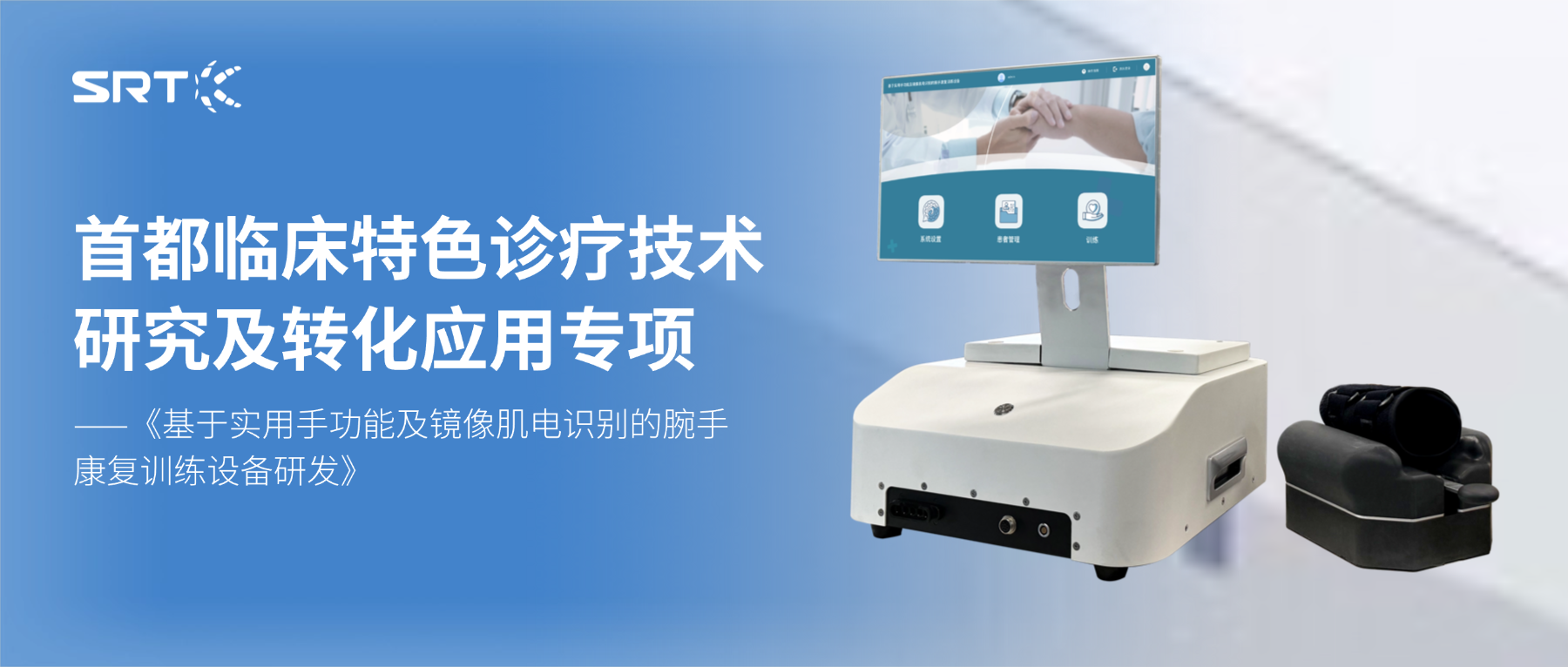
Recently, the project titled Development of a Wrist-Hand Rehabilitation Training Device Based on Practical Hand Function and Mirror Electromyography Recognition, a sub-project under the “Special Project for Research and Translational Application of Capital Clinical Characteristic Diagnosis and Treatment Technologies” of the Beijing Science and Technology Plan, successfully passed the acceptance review and was concluded. The project was led by Beijing Rehabilitation Hospital Affiliated to Capital Medical University, and jointly participated by Beijing Soft Robot Technology Co., Ltd. (SRT) and Beijing University of Technology.
Post-stroke hand dysfunction remains a major challenge in the field of rehabilitation. Existing rehabilitation devices still have limitations in terms of multi-degree-of-freedom thumb movement, wrist-hand coordination, and the precision of mirror training. To address these clinical needs, in this project, SRT focused its R&D efforts on the following technical aspects:
What is truly inspiring is that this project integrates the "central–peripheral–central" closed-loop rehabilitation concept. With the high-precision EMG feedback active intention recognition model developed by the team from Beijing University of Technology, the device can decode the patient's motion intention in real time, enabling mirror therapy controlled by the patient's "intention" from the unaffected hand. This results in higher patient initiative, making training no longer a passive mechanical repetition. Coupled with the virtual scenario-based interactive training system developed by SRT, patients can perform hand function rehabilitation training in simulated daily living scenarios, such as picking up a cup or using a mouse, significantly improving the practicality and engagement of rehabilitation training.
As an important part of the Beijing Science and Technology Plan Project, this research has completed technological exploration and prototype validation in areas such as soft actuation, EMG recognition, and wrist-hand coordination, providing a reference for the development of related rehabilitation devices. This project represents a technological practice by SRT in the field of soft robotics for medical applications. Going forward, SRT will continue to deepen its R&D efforts, committed to applying soft robotics technology to more medical rehabilitation scenarios, and providing safer and more compliant rehabilitation assistance solutions for patients with hand dysfunction.